What Was Required to Enter Temple in Jesus Day?
"Jesus and the Temple," Ensign, April. 1991, thirteen
No single place in all the world was holier to Jews and Christians at the time of Jesus than the Temple Mount. It was known as Har Habayit, the "Mountain of the Firm [of God]." On this sacred parcel of footing, the God of all creation had conversed with his prophets and priests, and on it a temple had been built to which He could come and in which his glory could dwell.

Illustrated past Leen Ritmeyer
Of course, God was not and is not limited to a building fabricated by man. Mountains of God—such equally Mount Sinai and the high mountains to which the brother of Jared, Nephi, and John the Revelator were caught abroad by the Spirit (meet Ether three:1; 1 Ne. xi:1; Rev. 21:x)—take often been the settings for templelike experiences.
The Savior himself sometimes "went up into a mount apart to pray." (Matt. 14:23.) He took Peter, James, and John to "an high mount autonomously" and was at that place glorified and transfigured before them; at that place they received the keys of the kingdom and heard the Father himself bearing witness of his Son. (See Matt. 17:i–nine; History of the Church, three:387.) Afterwards the Resurrection, the Savior gave his final charge and instructions to the eleven Apostles in "a mountain where Jesus had appointed them." (Matt. 28:16.)
These mountains were made holy by the divine presence of God.
The Savior and the Temple
But what of the Temple itself during Jesus' day? How did Jesus—the very Jehovah in whose name information technology had been built and to whom its sacrifices had been offered—regard the Temple congenital by Herod?
Although the architectural dazzler of Herod'due south Temple made information technology one of the wonders of the ancient earth, information technology had less of the hallowed and spiritual atmosphere that had infused the Tabernacle and Solomon's Temple. The ark of the covenant, Mercy Seat, Cherubim, and other holy objects were non there; the Urim and Thummim, which provided revelatory contact with God, was not at that place; and the Shechinah—the divine presence—was absent.
Yet Herod's Temple was a place of revelation, every bit seen in the experience of Zacharias. (See Luke 1.) And there is evidence in word and deed that Jesus considered the Temple to be the legitimate sanctuary of the true God. Indeed, Jesus chosen it "my Begetter'due south business firm" (John 2:sixteen) and "my house" (Matt. 21:13; Mark 11:17; Luke 19:46).
The Savior's life from offset to end was bound to the Temple. When Mary had fulfilled the forty-day ritual of purification after giving nascence, she and Joseph took the babe Jesus to the Temple in Jerusalem for the ceremonial redemption of the firstborn. (See Luke 2:22–24.) Twelve years later, Mary and Joseph "found him in the temple, sitting in the midst of the doctors, and they were hearing him, and asking him questions." (JST, Luke 2:46.)
Well-nigh the showtime of the Savior'southward ministry, "Jesus was taken up into the holy city, and the Spirit setteth him on the superlative of the temple." (JST, Matt. four:5.) In that location Satan made a vain effort to tempt him. During the three years that followed, Jesus was often in the Temple courts and in the Temple—that is, in diverse structures or colonnades of the inner Temple—though apparently not in the Holy Place itself (see illustration):
"The blind and the lame came to him in the temple; and he healed them." (Matt. 21:xiv.)
"About the midst of the feast Jesus went up into the temple, and taught." (John 7:14.)
"And early in the forenoon he came again into the temple, and all the people came unto him; and he sat downwards, and taught them." (John 8:two.)
"He taught daily in the temple." (Luke xix:47.)
"All the people came early on in the morning to him in the temple, for to hear him." (Luke 21:38.)
"I spake openly to the world," he said; "I ever taught in the synagogue, and in the temple, whither the Jews always resort; and in secret have I said nothing." (John xviii:xx.)
On at least one occasion, people in the Temple cried to him in praise, saying, "Hosanna to the Son of David." (Matt. 21:xv.)
Jesus was protective of the sanctity of his Father's house. In the very early on days of his ministry, he cleansed the Temple court of the merchandisers and money changers. (See John 2:13–16.) Then during his final calendar week in mortality, he again "went into the temple of God, cast out all them that sold and bought in the temple, and overthrew the tables of the money changers." (Matt. 21:12.)
As he taught, Jesus made figurative utilize of the Temple to foreshadow his death and resurrection: "Destroy this temple," he said, "and in 3 days I will raise it upwards.
"So said the Jews, Xl and six years was this temple in edifice, and wilt 1000 rear it upward in three days?
"Just he spake of the temple of his body." (John 2:19–21.)
At Jesus' death, the veil in the Temple's most sacred chamber, the Holy of Holies, was "rent in twain from the top to the bottom." (Matt. 27:51.) For generations, only the loftier priest had been permitted to laissez passer through the veil and enter the symbolic presence of God—and even he had that privilege simply once a year. Just through his death, Jesus rent that partitioning, signifying, amidst other things, that all people could achieve God'southward presence. (See Paul's caption of the symbolism, Heb. 9:11–fourteen; Heb. 10:19–22.)
Although the Temple had been built by a godless male monarch and was in the hands of priests who had strayed from the true knowledge of Jehovah, Jesus reverenced information technology and respected information technology. But he also acknowledged its position in relation to the true Lord of the Temple: "I say unto you," he told the Pharisees, "that in this place is one greater than the temple." (Matt. 12:half-dozen.)
The Temple at the Time of Jesus
It was said that whoever had not seen the Temple of Herod had never seen a beautiful building. No other temple complex in the Greco-Roman world compared with its expansiveness and magnificence. K priests trained equally masons helped to build the holiest parts of the Temple. Ten thousand workmen, using a 1000 wagons to ship materials, constructed the remainder of the building. The Temple proper took a year and a half to build; the courtyards and porticoes were under construction for 8 years. Boosted work and refinements on the Temple continued until A.D. 64, only six years earlier the Temple was destroyed by the army of Titus.
Herod nearly doubled the size of the Temple Mount from what it was during the catamenia of Solomon, making it in Jesus' 24-hour interval virtually forty acres. In comparison, Temple Square in Table salt Lake Metropolis covers 10 acres; the famous Forum in Rome was only 20 acres; and the largest temple complex in the world—Karnak, in Upper Egypt, which was two thousand years in the building—is threescore acres, only a 3rd larger than Herod's Temple Mount. (30-two American football game fields would fit on the Temple Mount!)
Solomon'due south Stables. To expand the Temple, Herod had to extend the platform of the Temple Mountain. To the northward and west he had his workmen bring in earth-fill to support the floor; just underneath the floor of the southern portion of the Temple courtyard are hollow chambers, vaults supported by rows of arched colonnades. Subsequently, Crusaders used these large, columned chambers for stabling their horses. Although Herod constructed them, they are erroneously called "Solomon's Stables."
The Tiptop of the Temple. The unabridged Temple area was enclosed by a high retaining wall. Since the southwestern corner of the wall provides the best angle for looking out over the city, a few recent researchers believe this is the Acme of the Temple where Jesus was tempted. In the ruins of that corner, researchers discovered a carved platform stone with a Hebrew inscription, indicating that this is where a herald would stand up to blow the shofar, signaling the advent of holy days.
The southeastern corner is the traditional candidate for the Pinnacle of the Temple. It is the highest bespeak forth the whole length of the walls of the Temple Mountain—211 feet, or 64 meters. From the top of this point to the lesser of the Kidron Valley was a drop of more than 400 anxiety—the highest man-made height e'er accomplished anciently in the Holy State. The indicate of Satan'southward temptation was to entice Jesus into misusing his divine power by throwing himself off the dizzying height and counting on angels to rescue him from the fall. (See Matt. 4:6.)
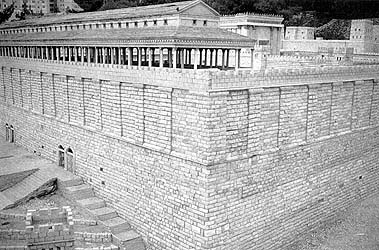

View at the southeast corner of the outer wall: (1) The Acme of the Temple—the highest bespeak forth the Temple Mountain walls. (2) The Huldah Gates, in the southward wall. (3) Herod'due south Basilica, the most imposing of all the porticoes, running the entire length of the southern wall. (4) The Holy Place, besides called the Sanctuary. (5) Antonia Fortress, named for Herod'south friend Mark Antony, where some Roman troops were housed and where Jesus may have been tried before Pilate. (Photography by D. Kelly Ogden.)
Huldah Gates. The main archway and exit to the Temple Mount were two gates, called the Huldah Gates, leading through the walls of the Temple Mount from the s. Through the one on the right, a person would enter to perform the holy work in the Temple, subsequently having gone through ritual washings or cleansings in small-scale pools or fonts only outside the walls. The left gate was the go out from the Temple Mount.
Susa Gate. The eastern gate of the Temple Mount was called the Susa Gate. It faced due east toward Susa (or Shushan), the Persian capital letter where parts of the biblical stories of Daniel, Esther, Nehemiah, and others unfolded. (See Dan. viii:ii; Esth. 1:two; Neh. 1:ane.) This gate was said to have been lower than the other gates so that the priests who were sacrificing a cherry-red heifer (a symbolic representation of the Redeemer) across the valley on the Mountain of Olives might look straight into the Temple.
Solomon's Porch. At ground level on all sides of Herod's Temple were extraordinary colonnaded porticoes (also chosen porches or cloisters)—covered walkways with colonnades opening to the inside. Each portico hosted a double row of Corinthian columns, each column a monolith cut from one cake of rock and rise to more than xxx-seven anxiety.
The porticoes inside Herod's newly positioned north, west, and south walls were unique to Herod's Temple. However, he built upward the eastern portico in the same spot as that of Solomon's Temple. This eastern portico, called Solomon'due south Porch (see one Kgs. 6:3), is perchance where twelve-twelvemonth-quondam Jesus conversed with the learned rabbis. (Encounter Luke 2:46.) Hither the Savior after walked and taught at the banquet of dedication (Hanukkah) and testified that he was God's Son; the Jews tried to stone him here on that occasion. (See John 10:22–39.) This is likewise where Peter and John, after performing a miracle at the gate of the Temple, drew a large crowd and preached, calling the people to repentance for denying and killing the Holy 1; here they were arrested by Temple police force and Sanhedrin officials. (See Acts iii:1–4:2.)


View of the Temple from the northeast corner of the outer wall: (1) The Susa Gate, which faces east toward the Mount of Olives. (2) Solomon'due south Porch (non visible), the eastern portico where twelve-twelvemonth-one-time Jesus may accept conversed with the rabbis. (iii) Herod's Basilica, also called the Imperial Porch, with its 162 Corinthian columns. (four) Court of the Gentiles, where Jesus cast out the money changers. (5) Balcony, the bulwark separating the Court of the Gentiles from the Temple. (Photography by D. Kelly Ogden.)
Herod's Basilica. The southern portico, grander than the others, is often called Herod's Basilica. (The word basilica comes from the Greek word basileus—"king"; therefore, this was considered to be a regal portico.) This rectangular public hall with colonnaded aisles had a full of 162 Corinthian columns. At its foot were ramps leading onto the Temple courtyard from the due south.
Court of the Gentiles. Solomon'southward Porch, Herod's Basilica, and the other cloisters or porticoes along the walls on the ground floor of the Temple complex opened onto the Court of the Gentiles, and so named considering non-Jews were allowed to enter. This is where people gathered to purchase and sell oxen, sheep, and doves for use in Temple cede and where money changers busily changed currency with pagan symbols and likenesses of polifical rulers into Temple coinage. Non-Jews were allowed to enter this far onto the Temple Mount, simply as members of other faiths are allowed onto Temple Square in Table salt Lake City. Of course, the Court of the Gentiles is where Jesus cast out the merchants and the money changers. (Run across John two:13–xvi; Matt. 21:12.)
Surrounding the Temple proper, separating information technology from the Courtroom of the Gentiles, was a balustrade (soreg in Hebrew)—a rock railing virtually four and a half feet high, with posted inscriptions in Greek and Latin alarm Gentiles non to pass within. One of these inscriptions, constitute in 1935 just exterior the Lion'south Gate of the Quondam City, is now on display in the Rockefeller Archaeological Museum. It reads: "No Gentile shall enter inward of the sectionalization and bulwark surrounding the Temple, and whosoever is caught shall be responsible to himself for his subsequent expiry."
Court of the Women. Through the balcony and upwards a level from the Courtroom of the Gentiles is the Court of the Women, the easternmost portion of the Temple proper, where Israelites—both men and women—were permitted to enter. The main gate into the Women's Court was called the Cute Gate considering of its rich decoration. At this gate, Peter and John, on their way to Temple worship, stopped to hear the petition of a lame man. Peter healed the man, who and then joined them in the Temple, "walking, and leaping, and praising God." (See Acts three:1–11.)
A fortified inner wall with towers, gates, and porticoes surrounded this court. Against the walls, within the porticoes, were chests for charitable contributions; this is likely the place chosen the "treasury," where the widow cast in her mites. (See Mark 12:41–44.)
The courtroom itself was a large space, nearly 2 hundred anxiety square. In the four corners were chambers that served various functions. Ane eastern bedchamber served the Nazarites; those who had made special vows could fix sacrifices there. The other eastern chamber was used for storing woods. One western bedchamber was used for storing olive oil. The other was a private ritual bathroom for purification of lepers.
It was perchance to this Courtroom of the Women that Joseph and Mary brought the infant Jesus five to half dozen weeks (forty days) after his nascency so that he, as a firstborn, could be redeemed and so that Mary could exist ceremonially cleansed. (See Luke ii:22–24.) Hither Jesus after taught during the Feast of Tabernacles (see John seven:2, 14; John 8:20) and diameter witness of his own divinity; dealt mercifully with the woman taken in infidelity; proclaimed himself to be the Low-cal of the World, the Messiah; and diameter testimony that he was the God of Abraham. In this court, angry Jews once again tried to stone him. (Run into John 7–8.)

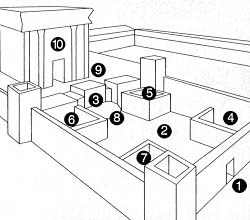
View of the inner Temple from its southeast corner: (1) The Cute Gate. (2) Court of the Women. (3) Nicanor Gate, named afterward the Egyptian Jew who donated the gate to the Temple. (4) Wood store. (5) Private bath where lepers could ritually purify themselves. (6) Oil shop. (vii) The chamber where Nazarites—those who had made special vows—could set their sacrifices. (8) Steps to the Nicanor Gate. (ix) Inner Courtroom. (10) The Holy Place. (Photography past D. Kelly Ogden.)
The Court of the Men of Israel and the Court of the Priests. Across the women'due south courtroom, fifteen curved steps led due west upward toward the Nicanor Gate. (Nicanor was a wealthy Jew from Alexandria, Arab republic of egypt, who donated the ornate doors of the gate.) This door opened into the innermost court of the Temple, which was really a double court. The first was the Court of the Men of Israel; next to information technology was the Court of the Priests. Simply priests and other authorized persons could enter this latter courtroom.

Some other view of the Nicanor Gate and the steps leading to it. On these stairs, Levites performed devotional music. (Photography by D. Kelly Ogden.)
Along the southern side of this courtroom was the "chamber of hewn stone" where the Sanhedrin met. Stephen was transfigured before the Sanhedrin here (see Acts 6:12–fifteen), and here Paul bore witness to the Sadducees and Pharisees (see Acts 22:30–23:10). Along the northern side of this court was the "chamber of the hearth," where priests on duty could spend their nights.

View of the inner court (the Court of the Men of Israel and the Court of the Priests), showing the horned Altar of Sacrifice and the Place of Slaughtering. (Photography by D. Kelly Ogden.)
Within this inner court were the Place of Slaughtering and the giant brass washbasin (the Laver) supported on the backs of twelve lions. (For all the water needs of the Temple Mount, millions of gallons of water were brought in from Solomon's Pools, s of Bethlehem, and stored in a continued series of rock-cut reservoirs.)
Near the Laver stood the great horned Altar of Cede, or Chantry of Burnt Offering. It measured 40 anxiety past forty feet past xv anxiety high. Some believe that the huge rock inside the Dome of the Rock, which now measures approximately 40 feet by 50 anxiety by 7 anxiety high, once formed the base of the chantry of sacrifice. It is clear that King David purchased the rock in order to build an chantry to the Lord. (Encounter 2 Sam. 24:eighteen–25.)
The chantry was made of whitewashed unhewn stone. A ramp 48 feet long and 24 anxiety wide led upward to it from the south. The altar stood off-center in the courtroom and so that the priest sacrificing the reddish heifer beyond the valley on the Mountain of Olives could see direct into the giant entryway of the holy sanctuary, which stood 66 feet high and 33 feet wide (20 by x meters).
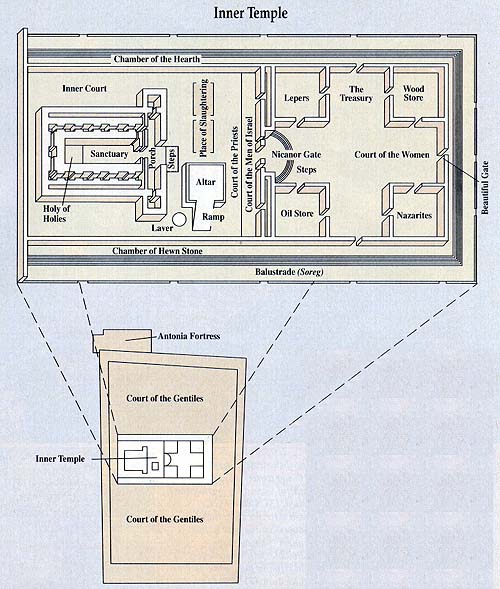
The Holy Place. Twelve additional steps beyond the Court of the Priests led to the Sanctuary, or Holy Place. Information technology was built on precisely the same site and to the exact dimensions as Solomon'southward Temple. As was the case in Solomon'due south Temple, the two columns in front end of the Holy Place were named "Jachin" and "Boaz" (meaning "He will plant" and "In him is strength"). The Sanctuary itself was made of marble. It was more than 150 feet high (today's Dome of the Stone reaches a height of merely over 100 anxiety), and was topped by golden spikes to discourage birds from landing on and tarnishing the rock.
Inside the Holy Place was the veil leading to the most sacred bedchamber, the Holy of Holies. In this chamber the affections Gabriel appeared to Zacharias to announce the impending birth of John the Baptist. (See Luke 1:five–23.) This is where the veil hung that was torn from top to bottom at the death of Jesus. (Encounter Matt. 27:51.)
Thus, the Temple area consisted of a series of rising platforms. From the Court of the Gentiles, one ascended stairs to the Court of the Women. From in that location, one ascended the 15 curved stairs, possibly singing the fifteen Psalms of Ascent (see Ps. 120–134), to the Court of the Men of Israel and the Court of the Priests. Finally, one made some other rising of twelve steps to the Holy Identify itself. Truly, "Jesus went up into the Temple." (John 7:fourteen; italics added.)
The 3 courtyards surrounding the holiest place where the Divine Presence could exist manifest may be compared to the three degrees of celebrity: telestial, terrestrial, and celestial. (Encounter 1 Cor. fifteen:xl–42.) Information technology is not plenty to progress into the third courtyard, or sky; to receive the fulness of the Lord's glory, one must really enter into the highest caste of that realm—to symbolically enter into God'southward presence and exist exalted.
1 of the Psalms of Ascent says, "I was glad when they said unto me, Let the states go into the house of the Lord.
"Our anxiety shall stand inside thy gates, O Jerusalem. …
"Whither the tribes go up, the tribes of the Lord, unto the testimony of State of israel, to give thanks unto the name of the Lord. …
"Pray for the peace of Jerusalem: they shall prosper that dear thee. …
"Because of the house of the Lord our God I will seek thy good." (Ps. 122.)
Sources
Avigad, Nachman. Discovering Jerusalem. Nashville: Thomas Nelson, 1980.
Ben-Dov, Meir. In the Shadow of the Temple—The Discovery of Ancient Jerusalem. Jerusalem: Keter Publishing House, 1982.
Edersheim, Alfred. The Temple—Its Ministry building and Services. K Rapids, Mich.: Win. B. Eerdmans Publishing Co., reprinted 1983.
Har-El, Menashe. This Is Jerusalem. Jerusalem: Canaan Publishing House, 1977.
Ogden, D. Kelly. Illustrated Guide to the Model City and to New Testament Jerusalem. 2nd ed., Jerusalem: The Jerusalem Center for Near Eastern Studies, 1990.
Ogden, D. Kelly, and Jeffrey R. Chadwick. The Holy Land—A Geographical Historical, and Archaeological Guide to the Country of the Bible. Jerusalem: The Jerusalem Heart for Near Eastern Studies, 1990.
Patrich, Joseph. "The Temple of Herod," in Bible Review. October 1988.
Yadin, Yigael, ed. Jerusalem Revealed. Jerusalem: The Israel Exploration Society, 1975.
Source: https://www.churchofjesuschrist.org/study/ensign/1991/04/jesus-and-the-temple?lang=eng
0 Response to "What Was Required to Enter Temple in Jesus Day?"
Post a Comment