Education highlights from Gov. Brown’s revised budget
The big pic
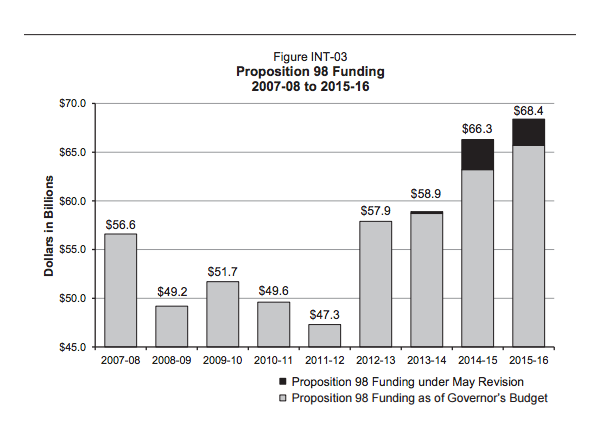
California is expected to get $half-dozen.7 billion more in revenue than originally anticipated in the January budget, bringing the total upkeep for Chiliad-12 in 2015-16 to $83 billion from all sources, according to Gov. Jerry Brown'south revised upkeep proposal. Based on how Proposition 98 works, $six.1 billion of that actress state acquirement is earmarked for 1000-12 schools and community colleges – a big win for education.
Local Control Funding Formula heave
The 50ocal Control Funding Formula volition become an additional investment of $2.1 billion, raising the total amount of cash for the state'due south school finance organization to $half dozen.1 billion. That means a $one,000 increase per student on boilerplate.
$iii.5 billion for Common Core, outstanding mandates debt
Schools will go $3.v billion in one-fourth dimension, discretionary funding through the reimbursement of unfunded mandates. The funding will get to school districts, charter schools, and county offices of education.
The budget recommends that districts use the money to farther implement the Common Core and new scientific discipline standards, through investments in professional person development, consecration programs for beginning teachers, instructional materials and technology for students and teachers.
Career Tech gets big budget crash-land

Gov. Jerry Dark-brown made career technical educational activity a focus of his January budget proposal, offering $876 million for job training programs every bit part of a larger statewide effort focused on reinvesting in California's workforce preparation efforts.
His May budget revision throws an additional $150 million toward career technical educational activity, proposing a total of $400 million next yr for his Career Technical Instruction Incentive Grant Program. First proposed in January, the programme asks districts to provide matching funds to qualify for the grants, which would be awarded to programs that promote regional partnerships to meet emerging workforce needs. California has already budgeted $500 million over the past two years for a like regional partnership grant program, the California Career Pathways Trust, simply districts don't need matching funds to qualify for that coin.
In Jan, Brown proposed $250 million over each of the adjacent 3 years for his Incentive Grant Programme. His May Revise tweaks that plan: Chocolate-brown is now calling for $900 million over the next three years, making $400 million available in 2015-16, followed past $300 1000000 in 2016-17, and $200 one thousand thousand in 2017-eighteen.
"This adapted schedule volition amend allow schools to transition to entirely using their own discretionary funds by 2018-19," Brown wrote in the revise.
"It was a huge step in January for the governor to acknowledge the need to maintain the set up-aside (funding) for career technical didactics, and the fact that he is now augmenting that first year by some other $150 million is huge," said Fred Jones, a spokesman for GetREAL, which advocates for career technical teaching in California.
Yet, Jones said many programs were cut or closed when career technical education lost its defended funding stream with the passage of the Local Command Funding Formula, which gives districts more control over how they spend their coin. Even the additional coin won't make upward for past losses, Jones said.
"The (allocation) is huge," Jones said. "We just now need to realize what the real world outcome is going to be on programs that accept already been cut and whether this is going to pb to an investment in rebuilding career tech."
Country Superintendent of Public Instruction Tom Torlakson praised the boosted money,
"This investment is in addition to the successful California Career Pathways Trust program, which has get a national model through funding innovative partnerships built among employers, schools and community colleges to railroad train and prepare students for the modernistic economic system," Torlakson said in a statement.
2,500 more office-time preschool slots in budget
The governor has proposed an additional 2,500 part-time preschool slots aimed primarily at children with special needs.
Early instruction advocates say 39,000 more preschool slots are needed to provide every low-income 4-year-old with preschool.
Brownish also proposes increasing funding to preschool programs past 1 per centum to support parent outreach, staff training and screening of children for disabilities.
"It'southward fantastic that he is recognizing the importance of these activities," said Erin Gabel, deputy director of Beginning v California. Just what Brown is proposing, Gabel said, "is a drib in the bucket in a robust Proposition 98 year for what we need to improve quality." She said she sees the May revision as an invitation for a more in-depth discussion with lawmakers about what is necessary to improve quality at land-funded preschools.
Special ed scores $60 million
The Statewide Special Teaching Task Force, a group convened to propose improvements to special education in California, got a shout-out in the May revision — and some coin for actions it recommended in its March final report.
The May revision calls for $threescore 1000000 in new funding ($50 million in ongoing funding and $10 one thousand thousand in i-time funding) to expand interventions for special needs children ages birth to 2, additional pre-school slots and an expansion of data-driven schoolwide behavioral supports.
The study didn't put a dollar figure on all of its recommendations, except to indicate it would be "a huge amount of coin," said Matthew Navo, superintendent of the Sanger Unified Schoolhouse District and a fellow member of the chore force. He added, "$60 million doesn't go very far, but it's a outset. It is a style for the governor to say we value the piece of work the chore strength did, and we're going to put some money in those areas."
Customs colleges become $1.ii billion more in funding
With boosted Proposition 98 money to spend, the governor's May revision includes an increase for California's community colleges.
The governor called for an additional $619 1000000 over what he proposed in January for the 112-campus organization, which would bring full community college funding to $one billion more 2014-15 levels. Among the highlights, the governor's proposal includes $75 one thousand thousand to hire more full-fourth dimension faculty and $60 million for programs that assist improve remediation rates for new students.
"Recent improvements in the state's financial status have enabled the states to serve more students and add back classes, simply our colleges are still dealing with the consequences of recession-era cuts that forced us to ration instruction," California Colleges Chancellor Brice Harris said in a statement. "The governor's revised upkeep proposal will aid our recovery and provide more access and back up for students to pursue their educational goals."
Coin for kids diverted to general purpose
Children Now said California is taking federal funds for children'southward health and sweeping them into the grandeneral fund.
When Congress overwhelmingly canonical a 23 percent increase in funding for the Children's Wellness Insurance Program (CHIP), it amounted to a $450 million windfall in California, according to Children Now. But those dollars accept been swept into the general fund instead of targeted for children's health, the group said.
"The diversion of the federal CHIP funding is like stealing from a child's piggy bank," said Children Now president Ted Lempert. "It's not acceptable. The land's upkeep priorities yet aren't in line with what Californians consistently say is their acme priority – our kids. State leaders have to bear witness they're set to walk the walk when it comes to making real, pregnant investments in the well-beingness of California children."
No tuition increase for UC; CSU gets funding increase
The governor'southward May revision also seeks to quell tensions over tuition increases at the University of California, offer a compromise on a tug-of-war over pupil fees between Dark-brown and UC President Janet Napolitano.
UC base tuition will remain at $12,192 a yr for the next 2 years under the deal. In add-on, UC would receive a 4 percent increase to its base upkeep in each of the next iv years and the state would provide $436 million over the next three years from the Proposition 2 "rainy day fund" to help UC pay down its pension obligations. The deal also includes $50 million for deferred maintenance and programs to promote energy efficiency.
In render, UC will aggrandize programs intended to help students graduate faster and transfer from community colleges. Notably, UC will streamline "transfer pathways" in its 20 most pop majors – modeling those efforts subsequently the associate degrees for transfer plan between customs colleges and California State University campuses.
For California Land University, the governor proposed adding $38 million to the $120 million he called for in January, for a total increase of $158 million. The money would support enrollment growth for four,000 students, plus enrollment of additional transfer students. CSU tuition would also remain flat adjacent year.
CSU officials had asked for $269 million.In a statement, Senate President pro Tempore Kevin de León defendant the governor of "shortchanging" CSU, which is the largest four-twelvemonth university system in the nation and is responsible for conferring more than half of all the bachelor's degrees awarded in the land.
The price to be a teacher
Instructor credential fees will leap from $70 to $100 under the May revision – a consequence of the decreasing number of teachers seeking certification in California.
Fees for credentials, examinations and accreditation go along the California Commission on Teacher Credentialing going, and those revenues have declined, according to the May revision, which includes an additional $4.5 million for the commission's budget. The new fees would utilise to an initial or a renewal teaching credential.
The California Department of Finance says the fees are not out of line. "Even with this proposed increase, teacher credential fees would remain lower than renewal fees charged to professionals in a number of other occupational fields," it said in a summary of the May revision.
To become more reports like this one, click here to sign up for EdSource's no-cost daily email on latest developments in educational activity.
Source: https://edsource.org/2015/education-highlights-from-gov-browns-revised-budget/79797
0 Response to "Education highlights from Gov. Brown’s revised budget"
Post a Comment